It’s 9.47 on a Tuesday night. The kids are finally down, the dishwasher is on, and you sit on the sofa for the first time since six o’clock this morning.
And you pick up your phone.
Not because you want to. Because stopping feels strange now. The quiet is louder than the noise.
If that’s you, you’re in good company. The Global Wellness Summit says looking after your nervous system is one of the defining wellness trends of 2026. Over a third of people in the UK say they’ve felt burnt out in the past year. There are hundreds of thousands of videos online about “regulating” yourself. Everyone, it seems, is trying to switch off.
Very few people are managing it.
The problem isn’t knowledge
You already know what helps. Breathe slowly. Put the phone down. Go for a walk. Go to bed earlier. None of this is a secret.
The problem is permission. Somewhere along the way, most of us decided that rest is what you earn once everything else is done. And everything else is never done.
Rizwana has spent more than twenty years as a psychotherapist, and she hears a version of the same sentence every week: I’ll look after myself when things calm down. Things don’t calm down. They just change shape.
Five things you can do tonight, for free
Before we tell you about anything we sell, here’s what we’d tell a friend:
- Breathe out for longer than you breathe in. In for four, out for six or eight, for two minutes.
- Leave the phone in another room for the first and last half hour of the day.
- Walk somewhere without headphones. Ten minutes of just the street.
- Check your shoulders, jaw and hands. Drop them. They’ll creep back up. Drop them again.
- Put one gap in your diary. Ten minutes where nobody needs anything from you. Treat it like a meeting you can’t move.
If those work, wonderful. You don’t need us.
For the people who can’t do it at home
Some people can. Most of the people we meet can’t, and they’ve stopped feeling guilty about it. At home there’s always a reason to get up: the washing, the email, the noise from upstairs.
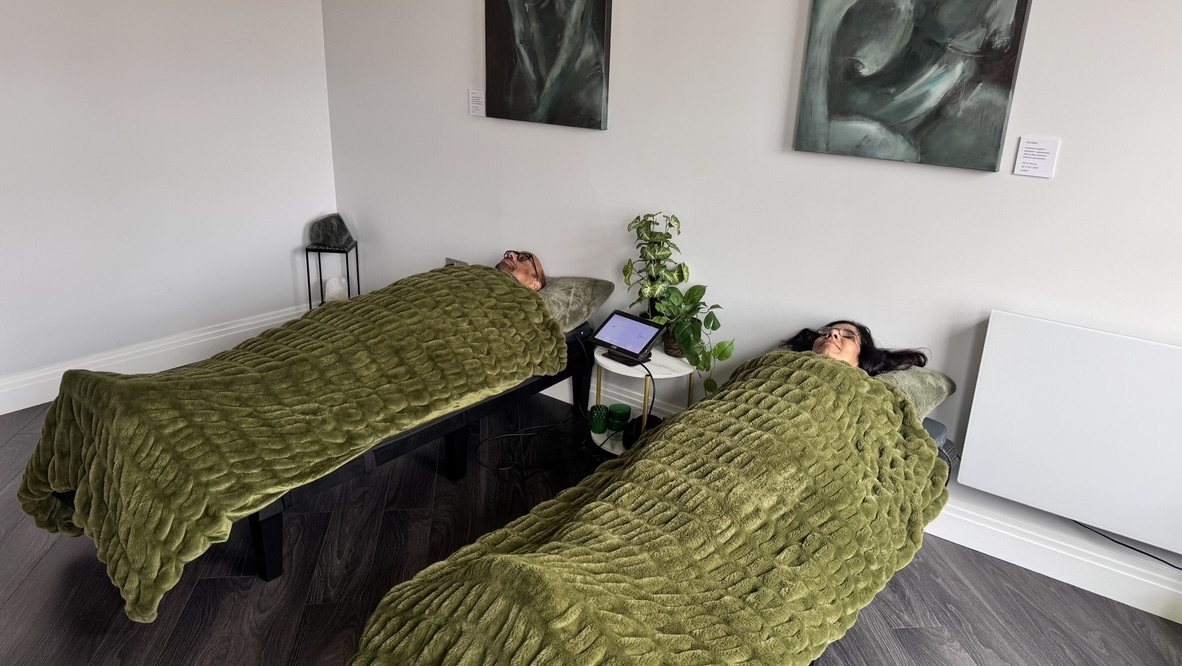
So they go somewhere else. They book an hour, the way you’d book a haircut, and they keep it. They walk up the stairs from Bath Passage, take their shoes off, hand their phone to their bag, and let someone else set everything up. For an hour, the only job is to lie there.
That’s most of what Transcend is. Not a machine that fixes you. A place where stopping is the point, and nobody thinks you’re lazy for doing it.
What stopping looks like here
- An hour in an oxygen chamber, under a blanket. Most people doze off within ten minutes.
- Half an hour on a PEMF mat in the quiet room upstairs, with light-and-sound glasses if you want them.
- Half an hour in a full-body massage chair, with nobody to make small talk with.
- Half an hour in the red light booth or the salt sauna, behind a closed door.
People like us
The people who come back aren’t wellness obsessives. They’re nurses and accountants and mums and builders. What they share is a decision: that an hour a week for themselves is not a treat, it’s maintenance. Like the dentist. Like the car.
We’ll never tell you a machine will “reset” you. If you’re struggling with anxiety, low mood or sleep that isn’t getting better, please talk to your GP or a therapist too. We’re here alongside that, not instead of it.
But if what you need is permission, consider this it.
Sources: Global Wellness Summit, Neurowellness (2026); Platinum Spas, The Wellness Trend Report 2026.